
All stories
Where Can I See Your Work?
Photographers, tailors, designers and hairdressers get asked to show their work. Here is how one link can answer, build trust and bring in better briefs.
Onyinye Ogbuka 10/21/2026 0 0
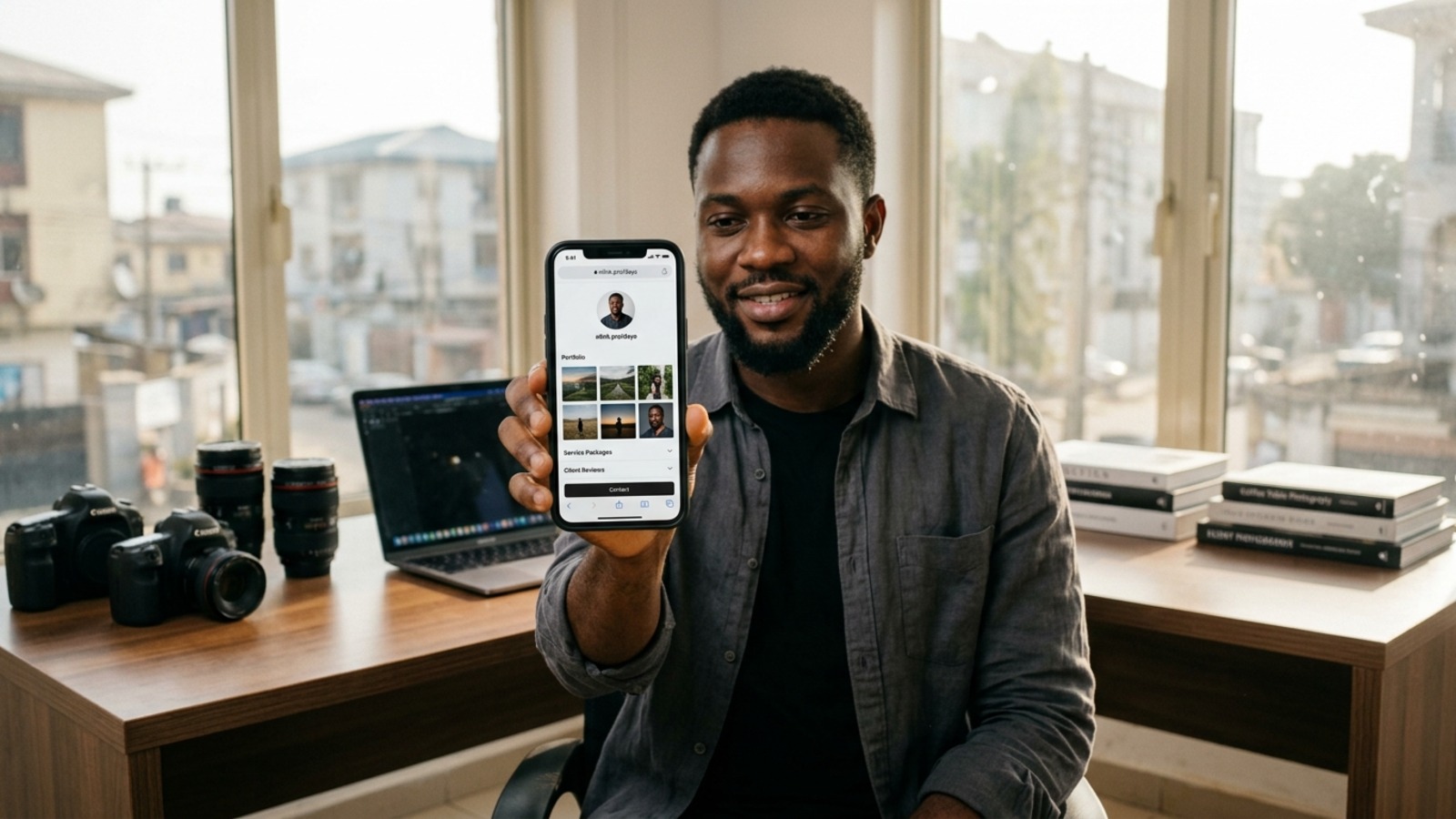
"Where can I see your work?"
If a potential client sent you that message right now, what would you reply with?
A screenshot?
Your Instagram handle and the words "scroll down a bit"?
A folder link that asks for permission?
A voice note explaining what you do?
For photographers, tailors, makeup artists, designers, tutors, consultants and other independent professionals, this is one of the most important questions you will ever be asked.
How you answer it often decides whether you get the job.
Why proof matters more when you sell yourself
When you sell a skill, customers cannot hold the product before they buy. They judge you by what they can see: your finished work, your results and how organised you seem.
Trust is the product.
The trouble is that most independent professionals keep their proof in too many places. Some work is on Instagram. Some was in a WhatsApp status that has disappeared. Some is on a laptop. Prices live in private chats. Reviews are screenshots saved somewhere.
So when someone asks to see your work, you send five links and hope the client opens all of them.
Many will not.
And when they do reach out, the brief arrives in pieces: a voice note here, a half-typed message there, a date mentioned in a different chat. You spend the first hour of every enquiry just collecting the basics.
Your work is good. Your proof is scattered. And scattered proof sells less than it should.
One link that answers the question
Now imagine you could answer "Where can I see your work?" with a single link. The person taps it and lands on a page that does the talking for you.
At the top, a clear line about who you are and what you do.
Below it, your best work: a gallery of photos, a few short videos, a selection of projects.
Next, your services and what they include.
Then reviews from people you have worked with, so a stranger can see that others trusted you.
And at the bottom, an enquiry form that asks for exactly what you need: the date, the type of job, the budget and the location.
The client has seen your work, understood your services and told you what they want, all before the first message. You open your inbox to an organised brief, not a blank chat.
That is what a reception does for an independent professional. It greets, shows proof and takes the brief.
Dayo; the smart business guy
Imagine Dayo, a photographer in Lagos who shoots weddings and portraits. Most of his work comes through referrals, and each one begins the same way: a friend of a friend asks, "Can I see some of your photos?"
Dayo used to send a link to his Instagram, then a link to a folder of full galleries, then a price screenshot from months ago. Half the time, the client went quiet.
Now imagine he has one page.
It shows his strongest wedding and portrait work, a short list of packages, two client reviews and a form. When someone asks, he sends one link. The client sees everything in a couple of minutes, fills in the form with their date and location, and Dayo replies knowing whether he is free and what the client needs.
He did not take better photos. He just made his proof easy to see.
How to build a proof page in five steps
1. Pick your best work. Choose five to ten pieces that show what you want to be hired for, not everything you have ever done.
2. Explain what you offer. List your services in plain language, with what is included and how a client can start.
3. Add trust. Include reviews, results or short notes from past clients. Even a few sentences help a stranger feel safe.
4. Add an enquiry form. Ask for the details you always need, so every brief arrives organised.
5. Use a short link for each place you share. Make one for your Instagram bio, one for your business card and one for a campaign or flyer. They all lead to the same page, but each is easy to remember and easy to say out loud.
Three mistakes to avoid
Showing too much. A page with a hundred photos is not a portfolio. It is an archive. Lead with the work you want more of.
Hiding your prices. You do not need to list every price, but give clients a sense of what to expect. It filters out the wrong enquiries and saves you time.
Letting the page go stale. Add new work regularly. A page that changes shows that you are active and in demand.
Make your next "Where can I see your work?" an easy yes
Your skills are probably already strong enough to win the job. Whether you win it often comes down to how easily a stranger can see them.
Nlink gives you a page at nlink.pro/yourname with a gallery, videos, services, reviews and enquiry forms, plus short links you can use wherever you share your work. It is built for phones, and setup takes a few seconds.
The free plan needs no credit card.
Claim your free Nlink page at https://nlink.pro/ and let your work answer the question for you.